
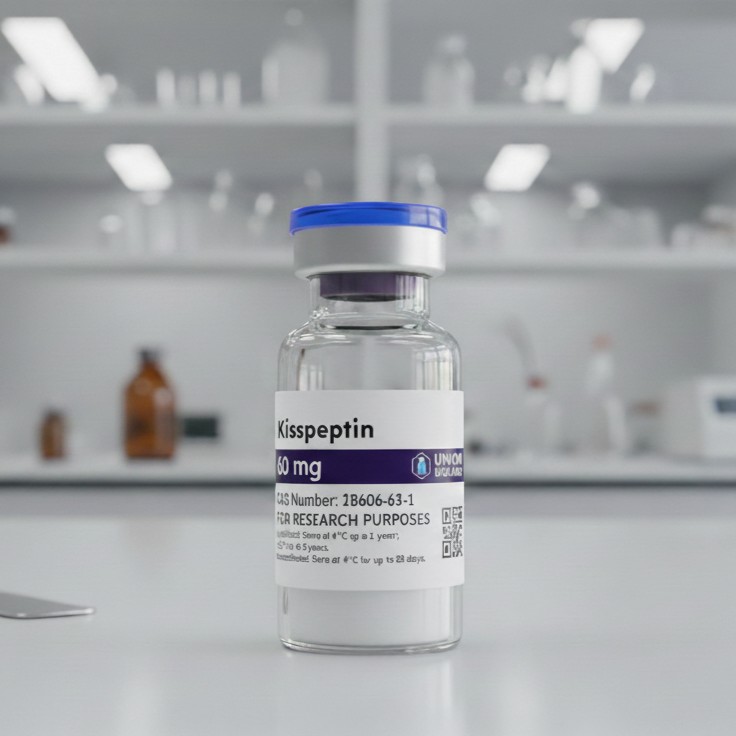
Kisspeptin 10 mg Research Peptide
Kisspeptin 10 mg is a high-purity, lyophilised research peptide developed for laboratory and scientific investigations. Also known as Kisspeptin-10, Metastin Fragment, and KP-10, this synthetic neuropeptide supports a wide range of biochemical and receptor-based studies. Every production batch undergoes rigorous quality testing to deliver exceptional purity, consistency, and reliability for demanding research applications.
We manufacture this Kisspeptin research peptide to a minimum purity of ≥98% (HPLC verified). Furthermore, every lot includes a Certificate of Analysis (COA), giving researchers complete batch traceability and quality assurance. The freeze-dried format improves long-term stability and allows convenient storage, transport, and reconstitution within established laboratory protocols.
Product Specifications
- CAS Number: 286026-83-1
- Synonyms: Kisspeptin-10, Metastin Fragment, KP-10
- Quantity: 10 mg (Lyophilised)
- Purity: ≥98% (HPLC Verified)
- Endotoxin: ≤5 EU/mg
- Sequence: Tyr-Asn-Trp-Asn-Ser-Phe-Gly-Leu-Arg-Phe-NH₂
- Length: 10 Amino Acids
- Molecular Formula: C₆₁H₈₄N₁₆O₁₃
- Molecular Weight: 1302.4 g/mol
- Documentation: Certificate of Analysis Included
Research Applications
Researchers commonly use Kisspeptin 10 mg for receptor binding studies, signalling pathway investigations, structural biology, biochemical analysis, and neurobiology research. In addition, its high purity supports experiments that demand accurate and reproducible results. Moreover, the lyophilised powder simplifies storage and handling, while helping laboratories maintain consistent research workflows.
Storage and Handling
Store the peptide at -20°C for long-term stability and protect it from light and moisture. For short-term storage, keep it between 2°C and 8°C. Additionally, avoid repeated freeze-thaw cycles because they can reduce peptide stability over time.
Laboratory Research Use Only
This Kisspeptin 10 mg research peptide is intended strictly for laboratory research purposes only. It is not approved for human or veterinary use and is not suitable for diagnostic, therapeutic, or medical applications. Therefore, always follow appropriate laboratory safety procedures and your institution’s handling guidelines when working with this research material.
| Weight | 50 g |
|---|---|
| Dimensions | 1 × 1 × 3 cm |
