
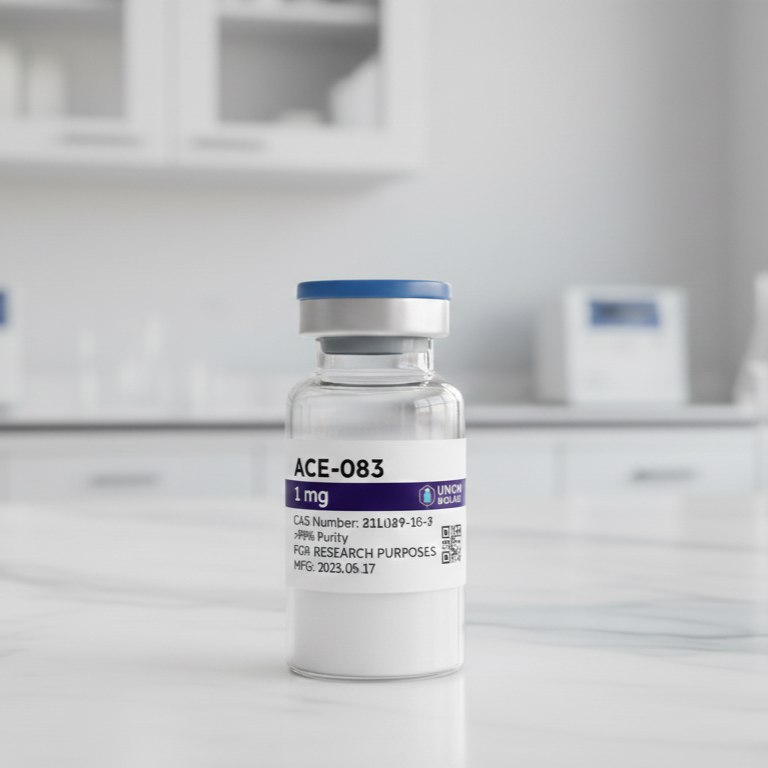
ACE-083 1mg
£85.00
Availability: Out of stock
You’ll get an email when it’s back in stock.
ACE-083 – 1 mg (Roledapam)
Product Overview
ACE-083 – 1 mg (Roledapam) is a recombinant fusion protein developed for laboratory research investigating skeletal muscle biology and myostatin pathway inhibition. It functions as an ActRIIB ligand trap that binds myostatin and related members of the transforming growth factor-beta (TGF-β) family. As a result, researchers can investigate muscle growth, regeneration, and neuromuscular disorders with greater precision.
Manufacturers produce ACE-083 as a high-purity lyophilised protein and include a Certificate of Analysis (COA) with every batch to ensure complete traceability and quality assurance. In addition, its high purity and low endotoxin levels make it suitable for sensitive in vitro and preclinical research workflows.
Specifications
- Product Name: ACE-083 (Roledapam)
- Synonyms: ActRIIB Ligand Trap, Investigational Myostatin Inhibitor
- CAS Number: 81080-10-6
- Quantity: 1 mg
- Form: Lyophilised recombinant fusion protein
- Purity: ≥95-98% (HPLC verified)
- Endotoxin: ≤5 EU/mg
- Documentation: Certificate of Analysis (COA) included with every batch
Research Applications
Researchers commonly select ACE-083 for:
- Myostatin inhibition studies
- Skeletal muscle growth research
- Muscle wasting disease models
- Neuromuscular disorder investigations
- Duchenne muscular dystrophy (DMD) research
- Activin receptor type IIB (ActRIIB) signalling studies
Storage & Handling
Store ACE-083 at -20 °C for long-term stability. However, you may keep it at 2-8 °C for short-term storage when necessary. Keep the vial dry and protected from moisture, and avoid repeated freeze-thaw cycles to preserve protein integrity throughout the study.
Why Choose ACE-083 – 1 mg?
- High-purity recombinant fusion protein
- HPLC-verified quality
- Low endotoxin specification
- COA included with every production lot
- Lyophilised for extended stability
- Suitable for advanced muscle biology research
Research Use Only
ACE-083 – 1 mg is supplied strictly for laboratory research purposes only. It is not intended for human or veterinary use. Furthermore, it is not approved for diagnostic, therapeutic, or medical applications. Researchers should handle this material using appropriate laboratory safety procedures and follow established scientific protocols at all times.
| Weight | 50 g |
|---|---|
| Dimensions | 1 × 1 × 3 cm |


